FilmEx is a mobile-first consumer platform that helps emerging Filipino filmmakers find, book, and connect with industry mentors. I designed the complete booking flow across 8 screens, from discovery and profile browsing all the way through scheduling, confirmation, and community engagement.
Mentors existed. Access didn't. And a platform that felt generic or transactional would get ignored.
Emerging filmmakers had no dedicated platform to find, evaluate, and book mentors. Discovery was scattered across Facebook groups and informal meetups. Scheduling was manual. And there was no structured way to build trust before committing to a session. The design problem was not just access. It was creating a transaction experience that felt safe enough to actually use.
"Everyone starts out as a rookie and every rookie would need a veteran/mentor to train them. Not every experienced person is open to taking someone as their apprentice."
Kat, 27"The industry is small but it's hard to penetrate, especially if you're shy and an introvert."
Daryll, 26"Networking isn't easy for someone who's shy, especially if you really have to get yourself out there. Not everyone in the industry is super nice either."
Jhoanna, 298 out of 8 filmmakers interviewed said they didn't know where to find mentors or opportunities.
Belonging before utility.
Spoke with 8 aspiring filmmakers aged 18–30 to understand their goals, frustrations, and how they currently find mentors and opportunities.
Discovered that a transactional matching model wouldn't work for this community. Relationships build through shared work and mutual visibility, not profiles and DMs.
Designed around a progression: personalized onboarding, a discovery hub, and a community space. From "here's who I am" to "here's what I'm working on" to "here's where we grow together."
Tested with 6 participants across remote sessions. Identified two critical iterations: reordering mentor bio information and adding progress indicators for task confidence.
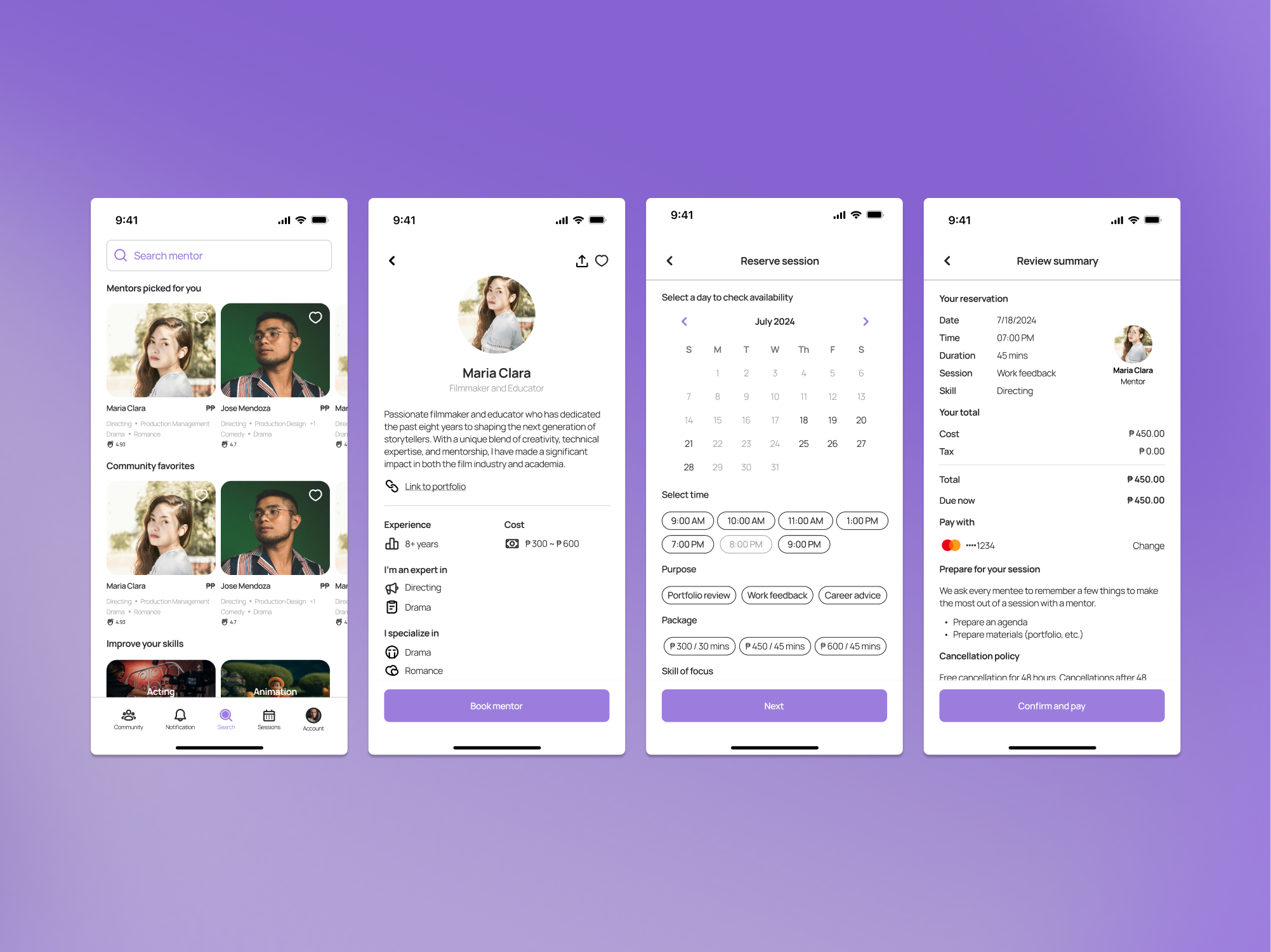
Designed 8 screens covering the complete user journey. Mentor browsing, profile evaluation, session type selection, scheduling, and booking confirmation. The focus throughout was reducing drop-off at each stage and making the next step feel obvious.
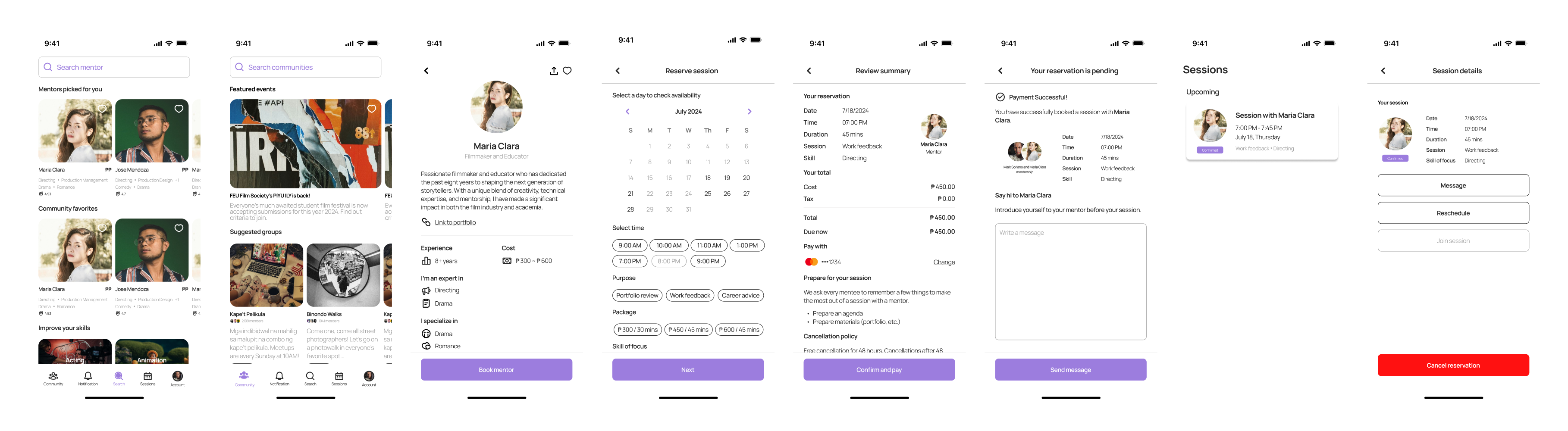
Eight screens. One complete booking experience.
The onboarding flow introduced FilmEx's value proposition before asking for any commitment. On the mentor profile screen, story and credentials led before pricing -- experience level, specialties, and a portfolio link were prioritized over cost because trust had to come before the transaction. This ordering came directly from research: filmmakers weren't avoiding mentors because of price, they were avoiding them because they didn't know who to trust.
The discovery screen surfaced mentors through two entry points: personalized recommendations based on onboarding inputs and a browse grid with specialty and rating filters. Community favorites were highlighted separately to surface social proof early. The booking screen broke scheduling into isolated steps -- date, time slot, session purpose, package tier, and skill focus -- to reduce cognitive load and prevent drop-off before confirmation. These were the two screens with the highest friction in usability testing, and both were iterated on based on participant feedback.
The review screen surfaced all booking details in a single glanceable view before confirmation -- it tested as the highest confidence moment in the entire flow. Post-booking, users landed in a community space with events, groups, and skill workshops, designed to give users a reason to stay engaged beyond their initial booking.
85% usability test success rate across 6 participants.
Key iterations reduced friction at the mentor profile and scheduling screens. Those were the two highest drop-off points we found in testing. The 85% success rate reflected not just task completion but how confident users felt at each stage of the transaction.
Trust is a conversion problem.
Designing for a community you have proximity to is both an advantage and a responsibility. The cultural context I brought accelerated my research, but I had to stay rigorous about not assuming my experience represented everyone's. I also noticed a pattern across FilmEx and Key for Business: users completing tasks weren't the same as users feeling confident. That distinction has changed how I approach usability testing permanently.
Designing a consumer booking flow taught me that trust is a conversion problem. Every screen between discovery and confirmation is a chance to lose the user. The decisions that mattered most were the ones that made the next step feel obvious and low-risk.